Article · October 29, 2026
Types of Flood Barriers: A Buyer's Guide to Matching the Barrier to the Opening
Automatic, hydrodynamic, aluminum stop log, portable ABS, Oxford, water-activated sandbag and glass flood wall barriers compared, and which suits which opening.
Most people start shopping for flood protection by searching for a product. It works better the other way around: start with the opening you need to protect, how often it floods, and whether anyone will be there when the water arrives. Those three answers rule out most options before price ever comes into it.
This guide walks through the main barrier types we supply, how each one works, and the kind of opening it suits. Every product is quoted for the site, so the aim here is to help you arrive at the conversation knowing which type to ask about.
Three questions that narrow the field
How wide and how high is the opening?
A pedestrian door, a double garage door, a loading dock and a riverside path are very different problems. Measure the clear width and decide how high you need protection to reach.
Who will deploy it?
Some barriers need a person to put them in place before the water arrives. Others operate on their own. If the building is empty at night or on weekends, or staff might not be able to get there during a storm, that matters more than anything else on this list.
How often does it flood?
A site that takes water every wet season can justify a fixed or permanently installed system. A site with an occasional risk may be better served by barriers that live in a storeroom until they are needed.
Barriers that operate on their own
Automatic Flood Barrier System
The Automatic Flood Barrier System uses water-level sensing and an electrically powered hydraulic pump to raise a barrier when floodwater reaches its configured activation level. When lowered it sits flush with the ground, and its top can be paved with pavers, stone or tiles so the barrier is concealed in the driveway or sidewalk. It sits in a shallow recess rather than a deep pit, which keeps excavation lower and leaves every part reachable at ground level for maintenance. Lowering and reset are handled by remote control or a central control switch.
It suits underground parking garages, unattended sites and critical infrastructure, provided the site has an appropriate power and control installation. Each system is custom-engineered to the opening and site conditions.
Hydrodynamic Passive Flood Barrier
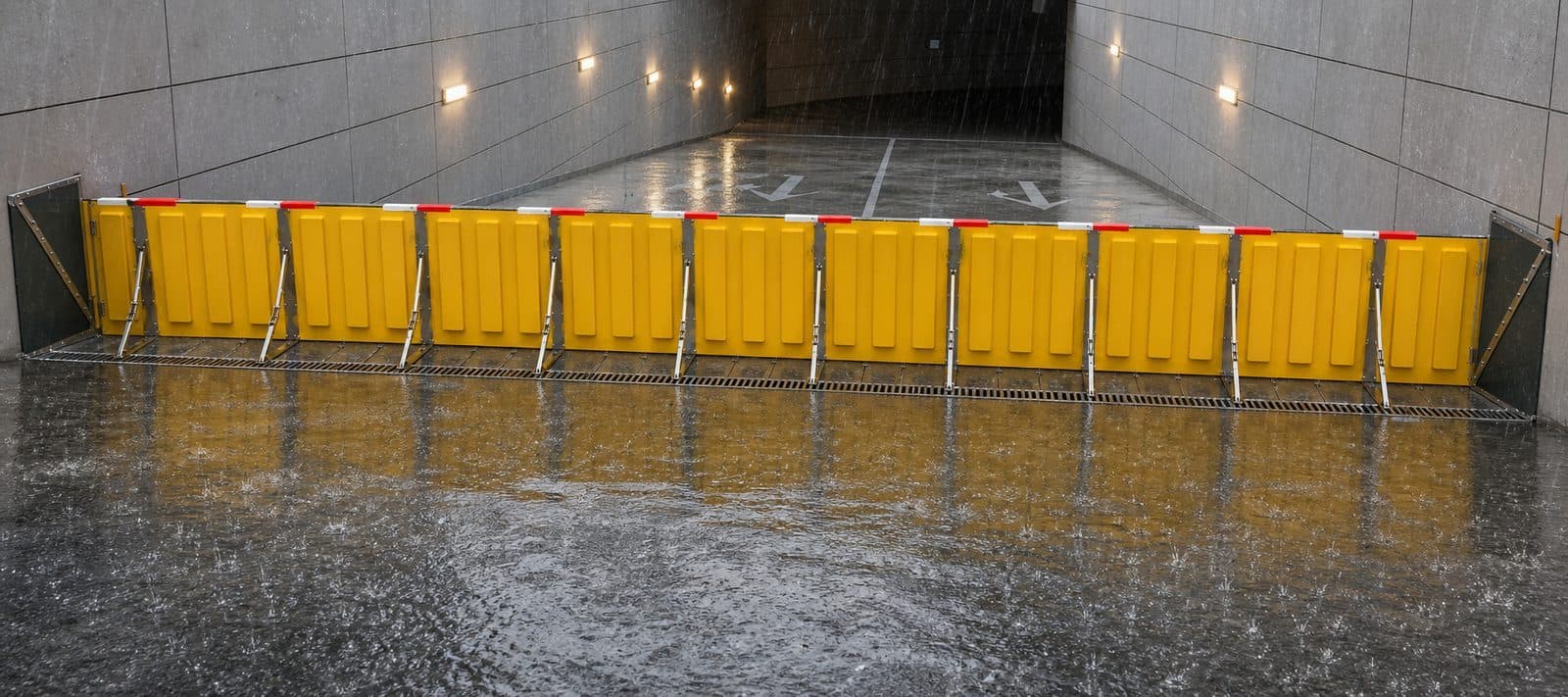
The Hydrodynamic Passive Flood Barrier needs no power at all to raise the barrier. As floodwater arrives it flows in beneath the panel, and buoyancy lifts the panel upright to close the opening. When the water recedes the panel lowers under its own weight, with nothing to reset. Protection height ranges from 0.6 m to 1.2 m (about 2 ft to 4 ft), and the width is made to the measured opening.
On a new build it sits in a recess flush with the finished surface. On an existing site it can be fixed onto the slab with a ramp on each side. When fully lowered it is trafficable to 20 tonnes GVM (about 44,000 lb). It suits basement parking entries, driveways, ramps and loading docks, especially where nobody can be relied on to be present.
Glass Flood Walls
Glass Flood Walls are fixed in position, so there is nothing to put in before a flood. Laminated glass panels sit in aluminum frames and posts with rubber seals at the panel edges, and the wall is fixed to a concrete base or parapet with foundations and anchors designed for the site. They suit riverside paths, waterfront parks and embankments where a solid wall would block the view. Panel layout and wall height are configured per project.
Barriers that a person puts in place
Aluminum Flood Barriers (demountable stop logs)
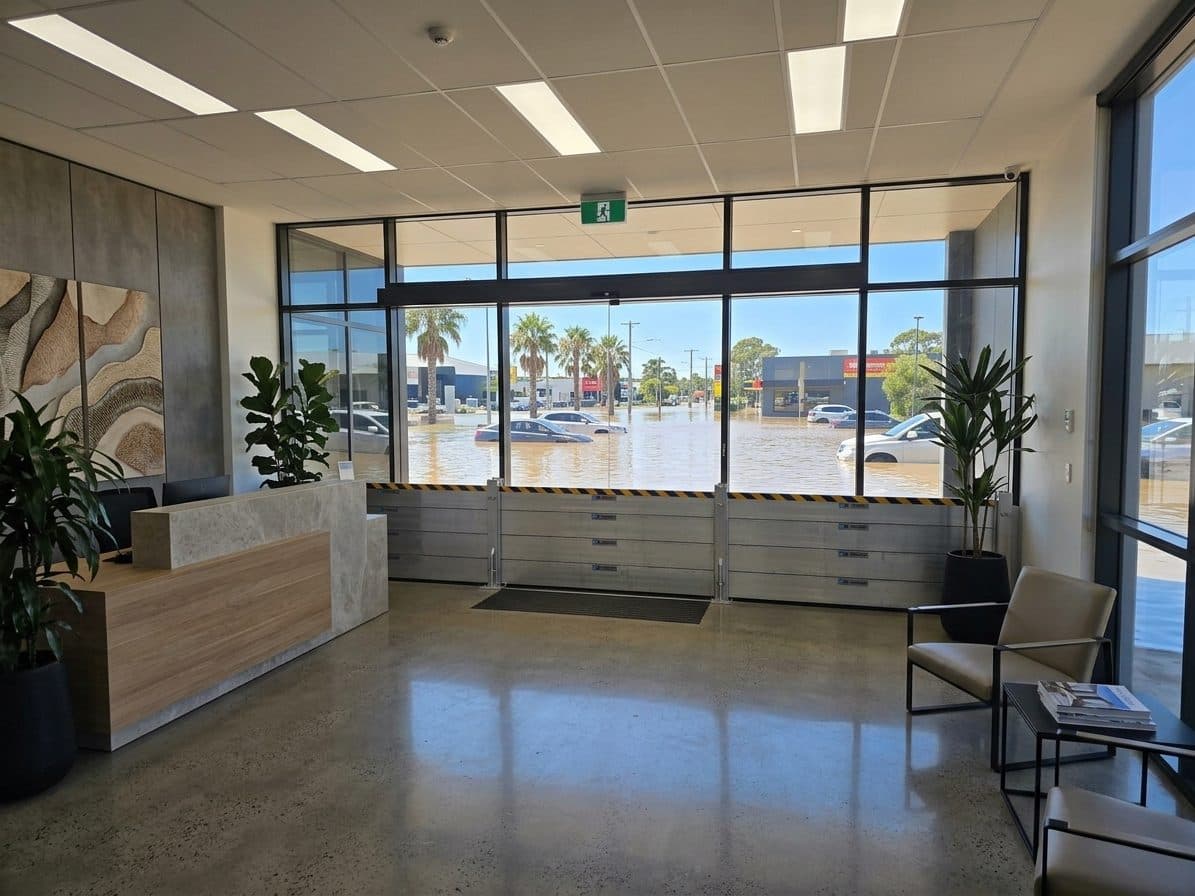
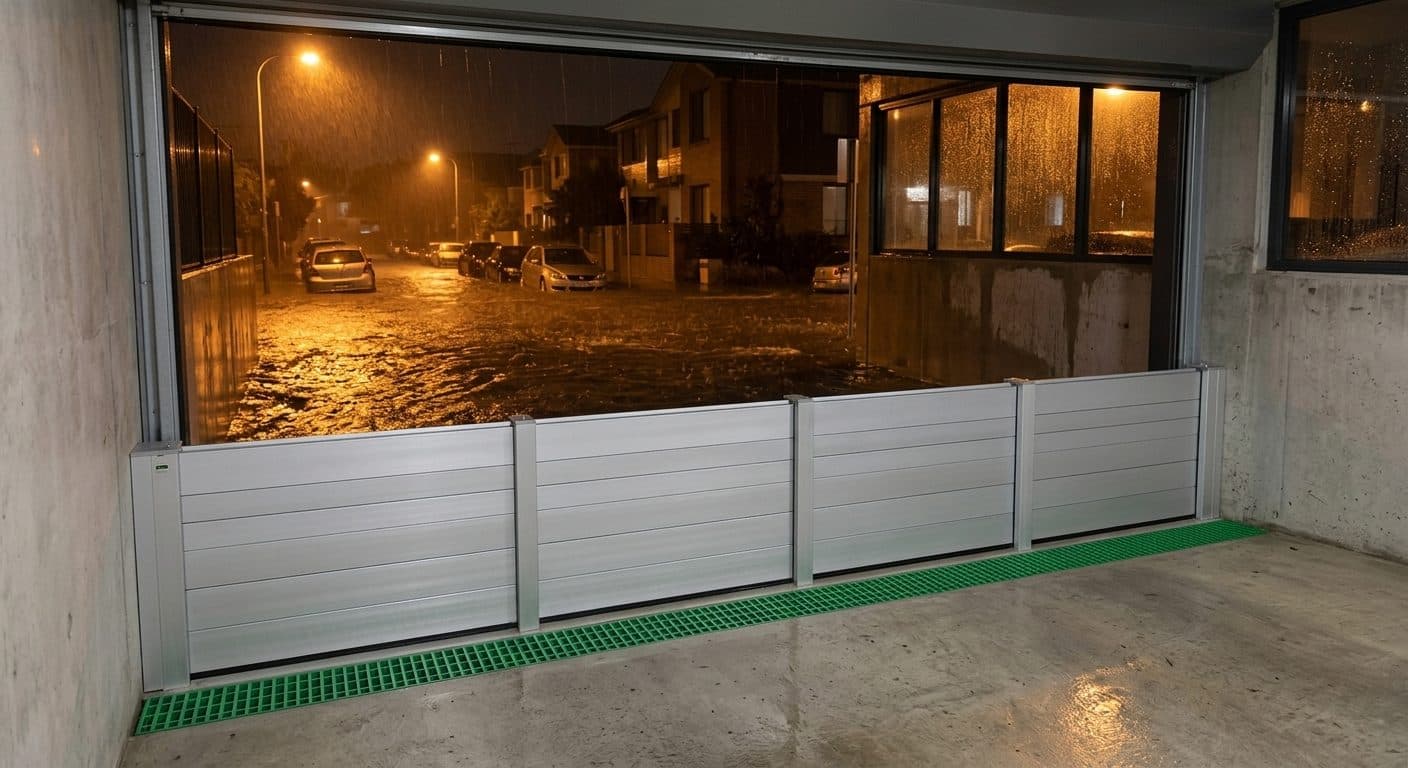
Aluminum Flood Barriers are made to measure. There is no standard size: each set is built to the measured width of the opening. The panels are 200 mm (about 8 in) high and stack in side channels, so the barrier height is set by how many panels go in, up to a maximum of 2,000 mm (about 6.5 ft).
Panels slot into the anchor channel by hand, and a wrench-tightened clamp at the top of each channel presses the stack down to compress the rubber gaskets and seals between panels and against the floor. One person can deploy or remove a set in under 10 minutes. When the water has gone, the panels lift straight out and the opening is back in normal use. The top panel carries a black-and-yellow hazard strip so it can be seen in poor light.
They suit shopfronts, building entrances, garage doors and loading areas that flood more than once and where someone can be on site when a warning is issued.
ABS Portable Flood Barriers
ABS Portable Flood Barriers are free-standing. Nothing is anchored, drilled or fixed to the building. The L-shaped panels are held down by the weight of the floodwater on their base, with no sand or fill, and they lock together side by side by hand. Seal strips run along the underside and side edge of every panel. Panels come in 750 mm (about 30 in), 1,000 mm (about 39 in) and 1,200 mm (about 47 in) heights, and the modular design can be configured to the width of the opening.
They hold back and divert floodwater, and some seepage can occur. They suit warehouses, parking lots, retail fronts and wide access points where fixing anything to the building is not an option.
Oxford Barriers (telescopic)
Oxford Barriers are built from PVC-coated Oxford cloth on a reinforced steel pipe frame. The telescopic width adjusts from 150 mm to 1,300 mm (about 6 in to 51 in), the protection height is up to 900 mm (about 35 in), and each barrier weighs 5.3 kg (about 11.7 lb). Water pressure presses the base against the ground. They work best on flat, smooth surfaces, and minor seepage can occur on uneven ones. They set up in minutes without tools, fold flat for storage, and connect to cover wider openings.
They suit house doors, garages, basements and small entrances where the risk is occasional and storage space is tight.
Water-Activated Sandbags
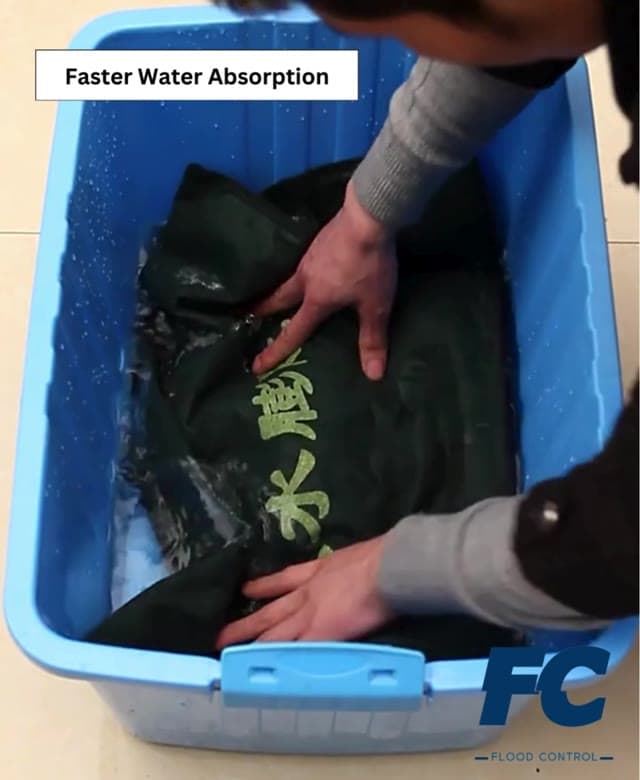
Water-Activated Sandbags store flat at 270 g (about 9.5 oz) each and swell to 18 to 22 kg (about 40 to 49 lb) within 2 to 3 minutes of contact with fresh water. They need no sand, shovels or filling. They are reusable and can be used repeatedly; how many times depends on how they are used. After the first activation they can stay in place outdoors to keep holding back water.
They suit low entry points, doorways, gaps around other barriers and anywhere you need something fast that takes up little room in storage.
Which barrier suits which opening
| Opening | Typical choice | Why |
|---|---|---|
| Underground parking entry or ramp, unattended | Hydrodynamic Passive Flood Barrier or Automatic Flood Barrier System | Operates without staff present |
| Shopfront or building entrance that floods often | Aluminum Flood Barriers | Made to measure, lifts out between events |
| Loading dock | Hydrodynamic Passive Flood Barrier, Aluminum Flood Barriers or ABS Portable Flood Barriers | Depends on traffic, height and staffing |
| Warehouse or wide access point | ABS Portable Flood Barriers | Free-standing, nothing fixed to the building |
| House door, garage or small entrance | Oxford Barriers or Water-Activated Sandbags | Compact storage, quick to set out |
| Riverside path or waterfront park | Glass Flood Walls | Permanent and keeps the view |
Combining barriers
Many sites end up with more than one type. A building might have a passive barrier at the parking entry, aluminum barriers at the front doors and a stock of water-activated sandbags for gaps and low points. No single barrier prevents all flood damage, so it is also worth planning for drainage or a pump on the protected side.
Getting a quote
Every product on this site is quoted. Send us the width and height of each opening, photos of the threshold and the area around it, and the flood height you want to protect against through our contact page. Flood Control is based in Sydney, Australia and supplies projects worldwide.
Recommended next step
Match the guide to a flood barrier option.
These are the product pages and guides most relevant to this topic. Use them to compare the options, then send us your openings for a recommendation and a quote.