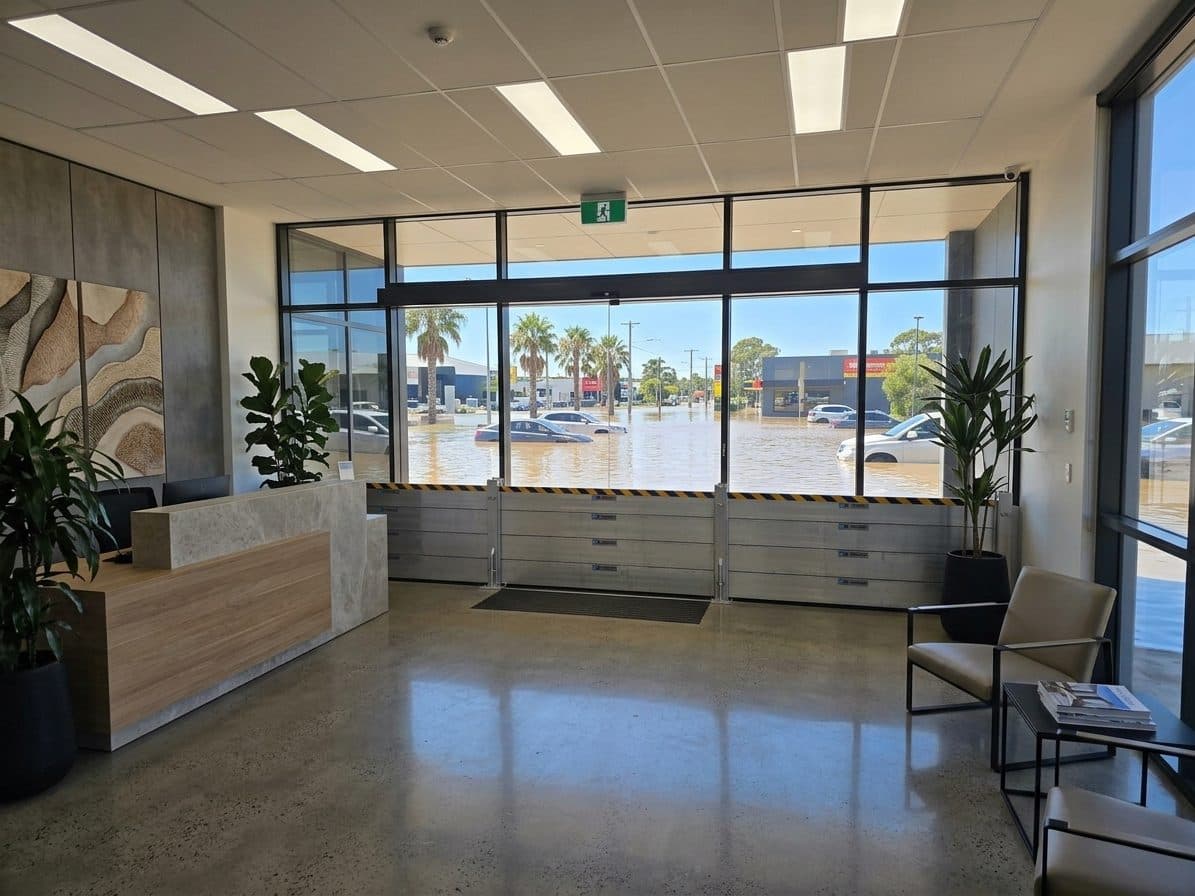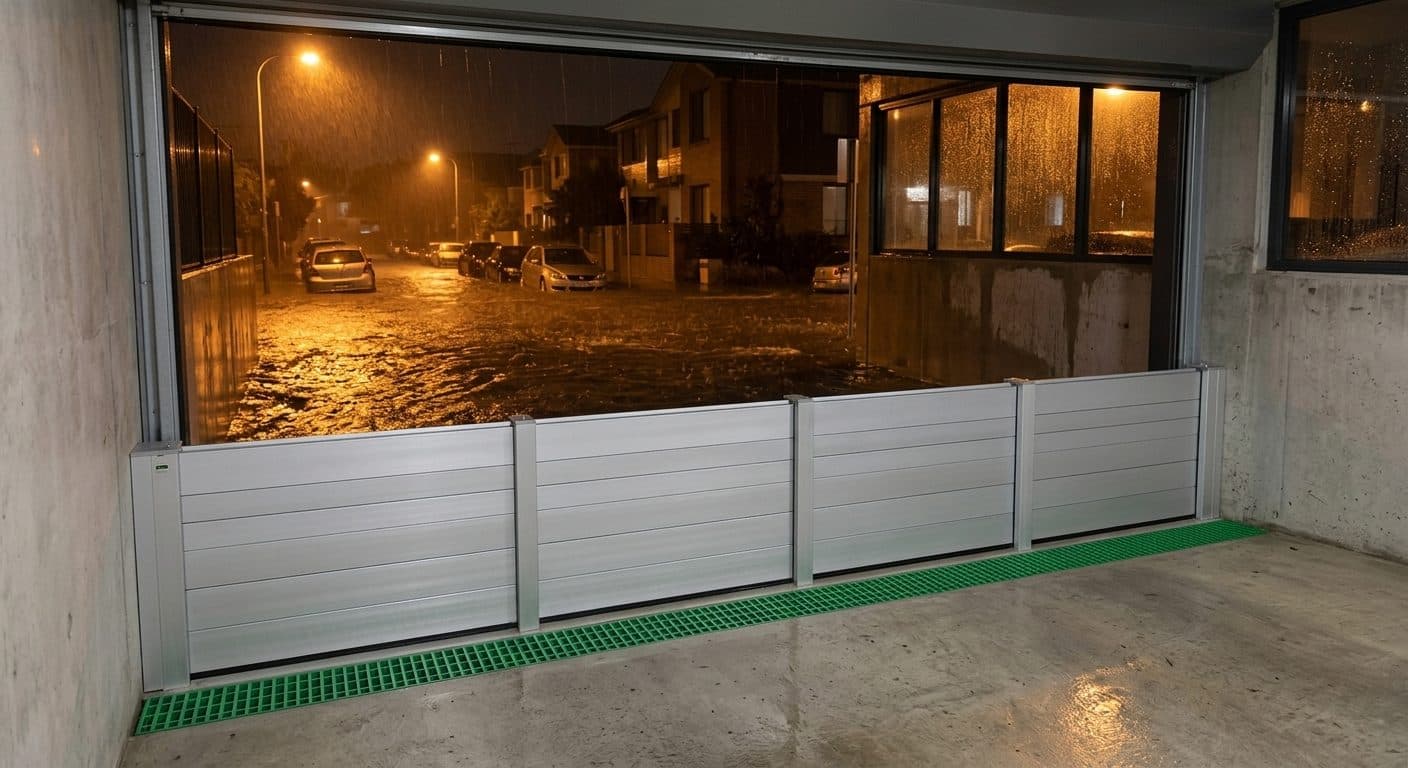
Article · October 29, 2026
Passive vs Automatic Flood Barriers for Parking Garages, Ramps and Loading Docks
Buoyancy-raised passive barrier or powered hydraulic barrier? How they compare on power, unattended operation, maintenance and fit for garages, ramps and docks.
An underground parking garage is often the lowest, most exposed point in a building. Water that gets down the ramp reaches vehicles, elevator pits, plant rooms and electrical switchboards, and it tends to arrive at night or during a storm, when nobody is standing at the entry ready to close anything. That is why the two options most owners end up comparing for ramps and garage entries are the ones that operate without a person: a passive barrier raised by the floodwater itself, and an automatic barrier raised by a powered hydraulic system.
Both sit at ground level in normal use and rise only when they are needed. The difference is what makes them rise.
How a hydrodynamic passive barrier works
The Hydrodynamic Passive Flood Barrier uses buoyancy. In normal use the panel lies flat across the entry. When floodwater arrives it flows in beneath the panel, and buoyancy lifts the panel upright to close the opening. As the water recedes, the panel lowers under its own weight and is ready for the next event. Nothing has to be switched on and nobody has to be on site.
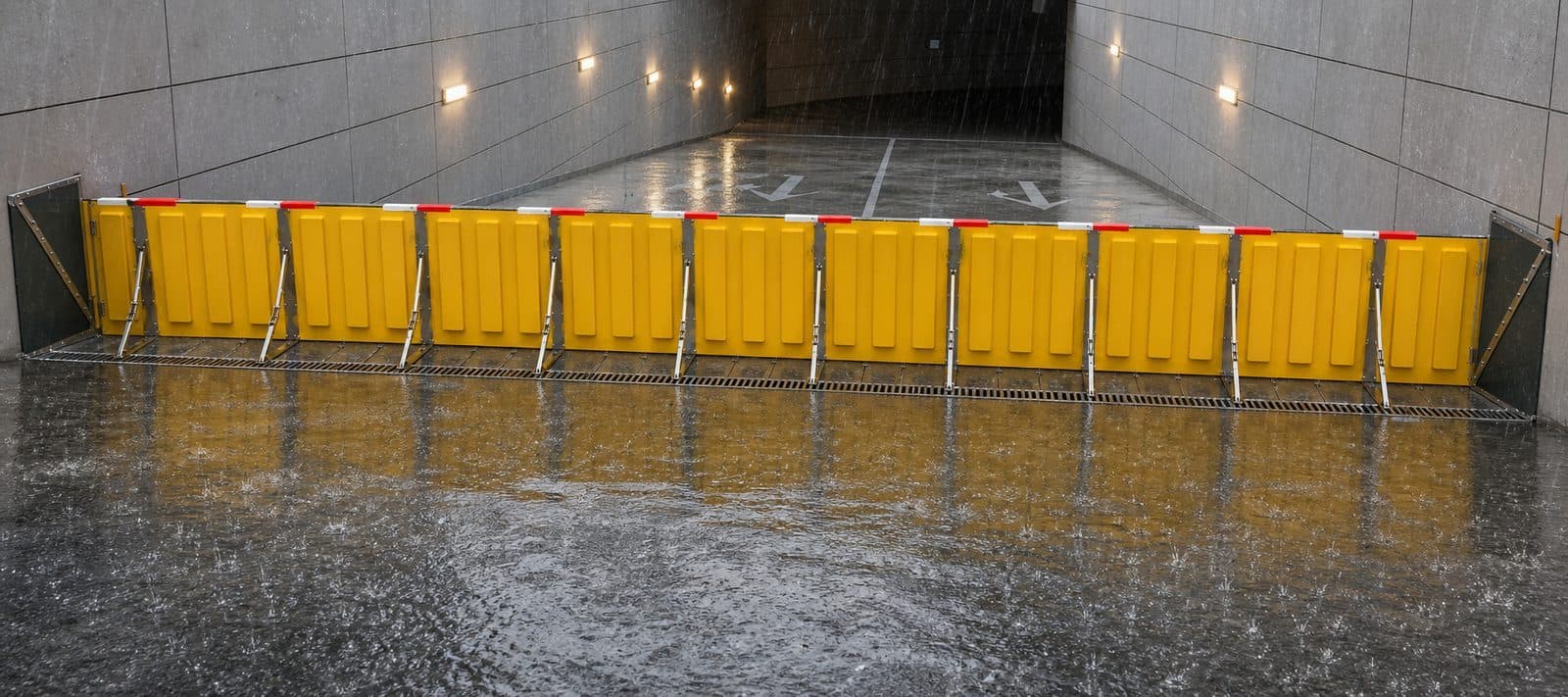
The construction is a 304 stainless-steel base frame with a buoyant polymer composite panel under a patterned steel top plate. An aluminum checker-plate top or anti-slip coating can be added for extra grip, and an optional flood alarm with a water-level detector flashes and sounds when floodwater reaches the barrier.
Protection height ranges from 0.6 m to 1.2 m (about 2 ft to 4 ft), and the width is made to the measured opening. When fully lowered it is trafficable to 20 tonnes GVM (about 44,000 lb).
How an automatic hydraulic barrier works
The Automatic Flood Barrier System uses water-level sensing and an electrically powered hydraulic pump. When the water reaches the configured activation level, the system raises the barrier. Lowering and reset are handled by remote control or a central control switch.
When lowered, the barrier sits flush with the ground, and its top can be paved with pavers, stone or tiles to match the surrounding surface, so it is concealed in the driveway or sidewalk. Each system is custom-engineered to the opening dimensions, site conditions and control requirements.
Comparing the two
| Hydrodynamic Passive Flood Barrier | Automatic Flood Barrier System | |
|---|---|---|
| What raises it | Buoyancy, as floodwater flows beneath the panel | Electrically powered hydraulic pump, triggered by water-level sensing |
| Power needed | None for barrier operation | Electrical supply for the pump and controls |
| Unattended operation | Yes | Yes, with an appropriate power and control installation |
| Reset | Gravity return as the water recedes | Remote control or central control switch |
| Lowered surface | Patterned steel top plate, optional checker plate or anti-slip coating | Can be paved to match the surroundings |
| Installation | Recessed flush on a new build, or surface-mounted with a ramp each side on an existing site | Shallow recess |
| Height and width | 0.6 m to 1.2 m high, width made to measure | Custom-engineered to the opening |
Power dependence
This is usually the deciding question. Storms that cause flooding can also cause power outages, so before choosing a powered system, ask how the site's supply will hold up when it is needed most and what the control design does if the supply is lost. Those answers are part of the engineering for each automatic system.
The passive barrier avoids the question for the barrier itself. It has no motors, pumps or electronics to raise it, so a blackout during a storm cannot stop it. If you add the optional alarm, that is a separate warning device and the barrier still operates without it.
Unattended operation
Both options are built for sites where you cannot rely on someone being there. The passive barrier deploys on its own at night, on weekends and on unattended sites. The automatic system raises itself when the water reaches its set level, and it is suitable for unattended sites when the power and control installation is designed for that.
For either one, the building's emergency plan should still say who is responsible for checking the entry and inspecting the barrier after an event.
Maintenance
Both systems sit in a shallow recess rather than a deep pit, which keeps excavation and site preparation costs down and leaves every part reachable at ground level for maintenance. The passive barrier has no motors, pumps or electronics to raise it, so there are fewer components to service. A powered system adds the pump, water-level sensing and controls to the maintenance schedule. Ask for the maintenance requirements in writing with the quote so the building manager can budget for them.
When each one fits
A passive barrier tends to suit
- Basement parking entries, ramps, driveways and loading docks where staff are not present around the clock.
- Existing buildings where cutting a recess into the slab is difficult; the barrier can be surface-mounted with a ramp on each side.
- Owners who want the barrier's operation to be independent of the electrical supply.
- Openings where the required protection falls within 0.6 m to 1.2 m.
An automatic system tends to suit
- Entries where the lowered barrier should disappear into the paving, such as a building forecourt or a public sidewalk.
- Sites that already have a reliable power supply and a building management team who want remote control over lowering and reset.
- Critical infrastructure and larger custom openings that call for a system engineered around the site.
Loading docks and ramps in particular
Loading docks often combine a wide opening with heavy vehicle traffic. Confirm the vehicles that will cross the barrier and how the dock is graded, because those details decide the configuration. On ramps, the barrier position matters: it usually goes at the top of the ramp, at the high point, so the protected side is everything below it. Water that falls inside the protected area, such as rain on the ramp itself, still needs drainage and pumping, because no barrier prevents all flood damage.
What to send for a quote
Both products are quoted per site. Send the clear width of the entry, the flood height you need to protect against, photos of the ramp or dock from the street and from inside, whether the slab is new or existing, and the vehicles that use it. Our contact page takes the details, and we will come back with the option that fits. Flood Control is based in Sydney, Australia and supplies projects worldwide.
Recommended next step
Match the guide to a flood barrier option.
These are the product pages and guides most relevant to this topic. Use them to compare the options, then send us your openings for a recommendation and a quote.